
The True Cost of In-House Printing for Mid-Size Businesses
You know what your company spends on paper and toner. But do you know what in-house printing actually costs you? Most mid-size businesses dramatically undercount their real print expenses because they only track the obvious line items. The hidden costs (labor, equipment depreciation, floor space, waste, and downtime) often double or triple the number you think you’re spending. This article will walk you through how to calculate your true print TCO (total cost of ownership), show you where the hidden costs live, and help you decide whether outsourced printing cost savings are worth pursuing for your organization.
What We’ll Cover in This Article
- What “in-house printing” actually costs beyond paper and toner
- The hidden cost categories most businesses miss
- How to calculate your true print TCO, step by step
- In-house vs. outsourced printing: a side-by-side comparison
- How to decide if outsourcing makes sense for your business
- What the transition to outsourced printing typically looks like
What “In-House Printing” Actually Costs
When most business owners or CFOs think about print costs, they think about consumables: paper, toner, ink cartridges. Maybe they include the lease payment on the copier. That’s the visible spend, and it’s usually only a fraction of the real number.
The industry benchmark is that most businesses spend 1 to 3% of annual revenue on print-related activities, and most of them aren’t tracking it. For a company doing $10 million in revenue, that’s $100,000 to $300,000 a year flowing toward print, much of it invisible on any budget report.
True in-house printing costs fall into two categories: direct costs you can see on an invoice and indirect costs buried across departments, workflows, and lost productivity. And print is just one piece of the total picture. When you add in related spend like the ROI of branded merchandise programs, the full scope of business services spending becomes even harder to ignore. Understanding both direct and indirect costs is the first step toward controlling them. If you’re already thinking about how managed print services fit into this picture, that’s the right instinct. But first, let’s understand what you’re really spending.
The Hidden Cost Categories Most Businesses Miss
Here’s where the real money goes. These are the cost categories that rarely show up in a “print budget” but absolutely show up in your bottom line.
Labor
Someone has to manage printers, order supplies, clear jams, coordinate repairs, and handle print jobs that require special attention. In most mid-size businesses, this work is split across office managers, administrative staff, and IT. None of them have “print management” in their job title, so the labor cost never gets attributed to printing. Conservatively, this adds 20 to 30% on top of your visible print spend.
Equipment and Depreciation
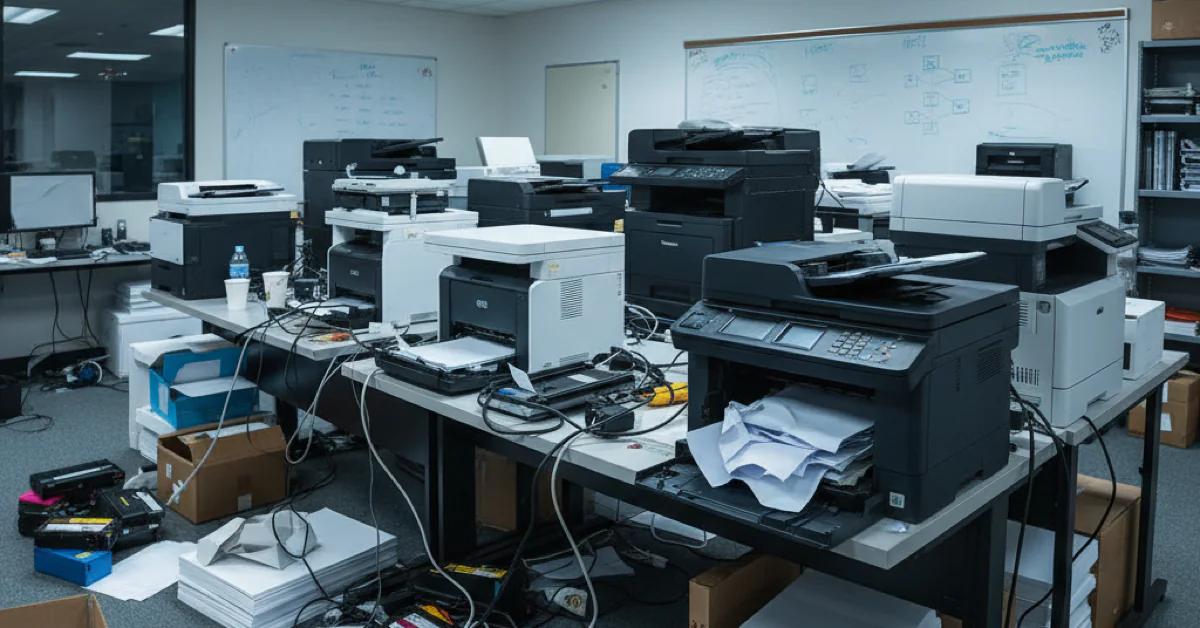
Printers, copiers, folders, inserters, postage meters. Whether you lease or buy, the cost doesn’t end at the purchase price. Maintenance contracts, parts, and eventual replacement all factor in. And if you own your equipment, the depreciation is a real cost even when you’re not writing a check.
Floor Space
Every printer, supply closet, and staging area for print jobs takes up space you’re paying for. In commercial office leases, that square footage has a real dollar value. A dedicated print room in a mid-size office can easily represent $500 to $1,500 per month in occupied space, depending on your market.
Waste and Overruns
Print errors, outdated materials, over-ordering to “get the better price,” and the forms that sit in a supply closet until they become obsolete. Most organizations waste 10 to 15% of what they print, and that percentage climbs higher for businesses that do large batch runs of materials that change frequently.
Downtime and Disruption
When a printer goes down during a critical run, the cost isn’t just the repair. It’s the delayed mailing, the missed deadline, and the staff scrambling to find a workaround. These costs are real but almost never tracked.
Opportunity Cost
This is the big one. Every hour your team spends managing print is an hour they’re not spending on revenue-generating work. For a $25/hour employee spending 5 hours a week on print-related tasks, that’s $6,500 a year in just one person’s diverted time.
How to Calculate Your True Print TCO
Here’s a practical framework you can use to get an honest picture of what print costs your organization. Set aside an afternoon for this. It’s worth it.
Step 1: Gather Your Direct Costs
Pull 12 months of invoices for:
- Paper and consumables (toner, ink, cartridges)
- Equipment leases or loan payments
- Maintenance and service contracts
- Postage and mailing costs
- Any outsourced print jobs you’re already sending out
Step 2: Calculate Your Labor Costs
Identify everyone who touches the print process. Estimate the percentage of their time spent on print-related tasks. Multiply by their fully loaded cost (salary plus benefits, typically 1.25 to 1.4x base salary).
Step 3: Add Facility Costs
Measure the square footage dedicated to print operations. Multiply by your cost per square foot (check your lease or use your area’s commercial average).
Step 4: Estimate Waste
Track your waste rate for one month. Include misprints, obsolete materials, and overruns. Extrapolate to annual numbers.
Step 5: Add It Up
Direct costs + labor + facility + waste + any downtime incidents = your true annual print TCO.
Most businesses find that their actual TCO is 40 to 60% higher than what they thought they were spending. That gap is where outsourced printing cost savings come from. According to Research Nester’s analysis of the commercial print outsourcing market, the industry is projected to grow from $94.6 billion in 2025 to $157 billion by 2035 at a 5.2% CAGR, with North America growing even faster at 8% CAGR. That growth is driven by businesses recognizing exactly this TCO gap.
In-House vs. Outsourced Printing: A Side-by-Side Comparison
| Factor | In-House Printing | Outsourced Printing |
|—|—|—|
| Per-unit cost | Lower on high-volume commodity jobs | Higher per piece, but includes labor and overhead |
| Total cost of ownership | Higher when all hidden costs are counted | Lower, typically 20%+ reduction in total spend |
| Staffing requirements | Requires dedicated or shared staff time | Handled by the vendor |
| Equipment responsibility | You own maintenance, upgrades, replacement | Vendor’s responsibility |
| Postal optimization | Limited, unless you have in-house presort capability | Presorting and co-mingling can save 8-15% on postage |
| Scalability | Constrained by equipment capacity | Scales up or down without capital investment |
| Quality consistency | Varies with equipment age and operator skill | Controlled by vendor SLAs and production standards |
| Turnaround flexibility | Fast for small jobs, slow for large or complex runs | Depends on vendor, but typically faster for large runs |
| Compliance and security | Your responsibility to build and maintain | Shared with vendor (verify their capabilities) |
One important note: per-unit cost comparisons often favor in-house printing for simple, high-volume jobs. But that comparison ignores all the hidden costs we’ve discussed. When you compare TCO, the math usually shifts. Data from PrintMail Solutions shows that credit unions, as one example, typically reduce print and mail costs by at least 20% after outsourcing, and postal optimization alone through presorting and co-mingling can save 8 to 15% on postage.
How to Decide if Outsourcing Makes Sense for Your Business
Not every business should outsource every print job. Here’s a straightforward framework to evaluate your situation.
Outsourcing probably makes sense if:
- Your monthly print volume exceeds 10,000 pieces and includes mail fulfillment
- You’re spending significant staff time managing print operations
- You have compliance requirements (HIPAA, financial regulations) that add complexity
- Your equipment is aging and you’re facing a capital refresh decision
- You need postal optimization but can’t justify the investment in presort equipment
Keeping it in-house might make sense if:
- Your print volume is low and simple (basic internal documents)
- Turnaround speed for small jobs is critical to daily operations
- Your existing equipment is new, paid for, and meets your needs
- You have dedicated staff who manage print efficiently alongside other duties
The honest answer for most mid-size businesses: a hybrid approach works best. Keep quick-turn, low-volume, internal printing in-house. Outsource high-volume, mail-intensive, and compliance-sensitive work to a partner built for it.
What the Transition to Outsourced Printing Looks Like
If you’ve run the numbers and outsourcing looks like the right move, here’s what the process typically involves.
Discovery and Assessment (2 to 4 weeks)
A good print partner will start by auditing your current print environment: volumes, job types, workflows, mail requirements, and compliance needs. This isn’t a sales pitch meeting. It’s a diagnostic.
Solution Design (1 to 2 weeks)
Based on the assessment, you’ll get a proposal covering which jobs to transition, projected costs, timelines, and service level expectations. This is where you compare the outsourced TCO to your current TCO calculation.
Pilot and Transition (4 to 8 weeks)
Most transitions start with a subset of your print work. You run the outsourced process alongside your existing one until you’re confident in quality, timing, and accuracy. Then you scale.
Ongoing Management
Regular reporting, volume tracking, and periodic reviews keep the relationship accountable. If you’re exploring outsourced printing services for the first time, expect a responsive vendor to provide monthly or quarterly business reviews.
Doceo Pro Tip
Before you request quotes from any print partner, run one month of tracking on everything your team prints. Include the stuff nobody thinks about: forms, labels, shipping docs, internal memos, compliance notices. Most businesses are shocked at the real number, and having that data makes every vendor conversation more productive.
FAQs
Q: How much can outsourcing printing actually save?
A: Most mid-size businesses see a 20 to 30% reduction in total print and mail costs when comparing full TCO. The savings come from eliminated labor, better postal rates, reduced waste, and no equipment overhead. Your specific number depends on your volume and current setup.
Q: What’s the difference between per-unit cost and TCO?
A: Per-unit cost is what you pay for each printed piece (paper, toner, click charges). TCO includes everything: labor, equipment, space, waste, downtime, and opportunity cost. Per-unit comparisons often favor in-house, but TCO comparisons almost always favor outsourcing for volumes above a certain threshold.
Q: Will I lose control over quality and timing?
A: A good outsourcing partner actually improves consistency because they run professional production equipment with quality controls. Timing is governed by service level agreements (SLAs), so expectations are clear. You should always ask for sample runs before committing.
Q: What about confidential or sensitive documents?
A: This is a critical question. Any print partner handling sensitive data should have documented security protocols, access controls, and, for healthcare-related work, HIPAA compliance with a signed Business Associate Agreement. Don’t assume this. Verify it.
Q: How long does the transition take?
A: Plan for 8 to 12 weeks from initial assessment through full production transition. Some businesses run faster, but rushing the pilot phase usually creates problems. A measured approach protects quality.
Q: Can I outsource some printing and keep some in-house?
A: Absolutely, and this is what most mid-size businesses end up doing. High-volume, mail-heavy, and compliance-sensitive jobs go to the outsourced partner. Quick-turn internal printing stays in-house. The key is drawing a clear line so nothing falls through the cracks.
Q: What if my volumes fluctuate seasonally?
A: This is actually one of the strongest arguments for outsourcing. You pay for what you use instead of maintaining equipment capacity for peak periods. A good vendor scales with your volume without requiring you to invest in additional infrastructure.
Next Step
If you’d like help thinking through your options, we’re happy to talk. No pressure, no obligation. Just a straightforward conversation about whether outsourcing makes sense for your specific situation.