

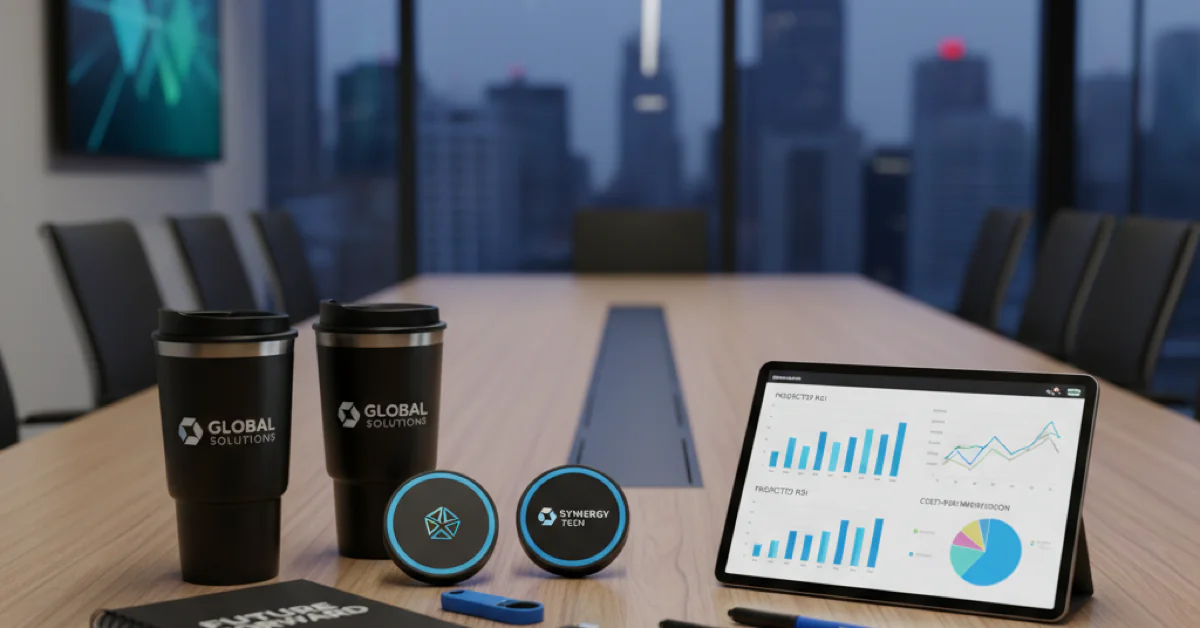
Branded Merchandise ROI: The Numbers Your CFO Wants to See
Branded merchandise gets a bad rap in budget meetings. It’s easy to dismiss as a “nice to have,” something the marketing team likes but finance can’t measure. The truth is, promotional products are one of the most cost-effective brand impression channels available, and the data backs that up. This article gives you the numbers, the framework, and the talking points to demonstrate branded merchandise ROI and build a case for a structured program your CFO will approve.
What We’ll Cover in This Article
- What branded merchandise ROI actually means (and how to define it)
- The cost-per-impression comparison: merch vs. digital ads
- Key ROI metrics for branded merchandise programs
- How to calculate your branded merch ROI
- Company stores: reducing hidden costs while increasing brand consistency
- How to build a merch program your CFO will approve
What Branded Merchandise ROI Actually Means
ROI on branded merchandise isn’t mysterious. It’s the measurable return your company gets from investing in promotional products, expressed as brand impressions, recall, engagement, or revenue influence per dollar spent.
The challenge? Most companies never set up tracking. They order 500 t-shirts for a trade show, hand them out, and move on. There’s no baseline, no impression estimate, and no follow-up. That’s not a merch problem. That’s a measurement problem.
When you apply the same rigor to merchandise that you’d apply to a paid media campaign, the numbers get interesting fast.
The U.S. promotional products industry hit $27.8 billion in 2025, according to ASI and IBISWorld. Globally, the market is projected to grow from $26.5 billion to $37 billion by 2033 at a 3.75% compound annual growth rate (CAGR), per the GiftAFeeling Industry Report 2025. Companies aren’t spending at this scale on guesswork. They’re spending because it works.
The Cost-Per-Impression Comparison: Merch vs. Digital Ads
This is where the conversation shifts from “nice to have” to “why aren’t we doing more of this?”
Promotional products generate impressions at less than $0.01 per impression, according to the ASI Ad Impressions Study. A single branded bag generates over 3,000 impressions across its lifetime. Compare that to what you’re paying for digital:
Cost Per Impression by Channel
| Channel | Cost Per Impression | Average Lifetime | Brand Recall |
|———|——————-|——————|————–|
| Branded merchandise (bag) | Less than $0.01 | 1+ years (63% keep items over a year) | 85% remember the advertiser |
| LinkedIn ads | $0.01–$0.018 | Seconds | Varies, typically low |
| Google Display ads | ~$0.012 | Seconds | Varies, typically low |
| Facebook/Meta ads | $0.005–$0.015 | Seconds | Varies, typically low |
| Direct mail | $0.03–$0.10 | Days to weeks | Moderate |
Sources: ASI Ad Impressions Study, LinkedIn Ad Benchmarks, Google Ads Benchmarks
Here’s what makes this comparison so lopsided: digital impressions are fleeting. A LinkedIn ad appears for a few seconds in a feed and it’s gone. A branded bag sits on someone’s shoulder at the grocery store, at the gym, at work, generating impressions every time someone sees it. And 63% of recipients keep promotional products for more than a year (ASI).
That means a single item keeps working long after a digital campaign has ended.
Key ROI Metrics for Branded Merchandise Programs
If you want to present a branded merchandise ROI case that holds up under scrutiny, you need four metrics:
1. Cost per impression (CPI). Total program cost divided by total estimated impressions. For most merch programs, this lands well under a penny per impression.
2. Brand recall rate. According to ASI, 85% of people remember the advertiser who gave them a promotional item. That’s a recall rate most digital channels can’t touch.
3. Recipient action rate. ASI research shows 79% of recipients are more likely to do business with a brand after receiving a promotional item. This is the metric that connects impressions to revenue.
4. Lifetime impressions per item. Different items generate different volumes. Bags and outerwear sit at the top (3,000+ impressions). Pens and drinkware are close behind. The key is selecting items people actually use, not items that go straight into a drawer.
How to Calculate Your Branded Merch ROI
Here’s a practical framework you can adapt for your own program:
Step 1: Define your total program cost. Include item cost, decoration (printing/embroidery), shipping, storage, and distribution labor. Don’t forget the hidden costs: rush orders, reorders of wrong sizes, and one-off requests from different departments.
Step 2: Estimate total impressions. Use ASI benchmarks as your baseline. A branded bag generates roughly 3,300 impressions. A branded shirt generates roughly 2,450. A pen generates roughly 700. Multiply by quantity ordered.
Step 3: Calculate your cost per impression. Total cost divided by total impressions. For a well-run program, you should see numbers in the $0.002–$0.008 range.
Step 4: Compare to your digital CPI. Pull your actual LinkedIn, Google Display, and social CPI from your ad platform dashboards. Place them side by side with your merch CPI.
Step 5: Factor in recall and action rates. Apply the 85% recall rate and 79% likelihood-to-do-business rate to your impression numbers. This gives you an adjusted “effective impressions” figure that accounts for the quality difference between a physical item someone uses daily and a digital ad they scroll past.
Example calculation: 500 branded bags at $8 each = $4,000 total cost. At 3,300 impressions per bag, that’s 1,650,000 total impressions. Your CPI: $0.0024. Compare that to LinkedIn at $0.01–$0.018 per impression.
Company Stores: Reducing Hidden Costs While Increasing Brand Consistency
One of the biggest drains on merch ROI isn’t the merchandise itself. It’s the chaos around ordering it.
When every department orders independently, you get inconsistent logos, off-brand colors, rush shipping fees, and overstock sitting in closets. A company store (an internal online portal where employees order pre-approved, branded items) solves most of these problems at once.
Company stores are the fastest-growing segment in promotional product distribution, according to PPAI Expo 2026 reporting. And 54% of distributors now offer print-on-demand options (ASI Research 2025), which means you can reduce inventory risk by printing items only when they’re ordered.
The ROI impact of a company store solution is twofold: you cut waste and you protect brand consistency. Both of those translate directly to better cost per impression.
The workwear and uniform segment alone is a $19.2 billion market in 2025, projected to reach $28.1 billion by 2033 at a 4.9% CAGR (Grand View Research). If your team wears branded apparel, that’s a walking billboard you’re already paying for. A company store makes sure it looks right.
How to Build a Merch Program Your CFO Will Approve
CFOs don’t reject merch because they hate branded water bottles. They reject it because no one presents it as a measurable investment. Here’s how to change that:
1. Lead with the CPI comparison. Show the cost-per-impression table above. When your CFO sees that merch generates impressions at a fraction of digital ad costs, the conversation shifts.
2. Set a baseline. Before you launch, document your current brand recall, employee satisfaction with branded items, and any existing merch spend (including the scattered, department-level purchases most companies don’t track).
3. Consolidate through a company store. Present the cost savings from eliminating rush orders, reducing overstock, and standardizing branding. This is the “efficiency” argument that speaks finance language.
4. Start small and measure. Propose a pilot program with three to five core items. Track impressions, gather recipient feedback, and report results quarterly.
5. Connect to recruiting and retention. Branded merch isn’t just external marketing. Quality branded gear for employees reinforces culture and pride. That’s harder to quantify, but your HR team will back you up.
Doceo Pro Tip
Start your merch program with three items your team will actually use daily: a quality bag, a good pen, and a branded water bottle. These three items alone generate more brand impressions per dollar than almost any digital campaign you’ll run this year.
FAQs
Q: What’s a good ROI benchmark for branded merchandise?
A: If your cost per impression is under $0.01 and your brand recall exceeds 80%, you’re performing well. Most structured merch programs outperform digital ads on both metrics.
Q: How do I track impressions from branded merchandise?
A: Use ASI’s published benchmarks as your starting point (e.g., 3,300 impressions per bag). For more precision, survey recipients on usage frequency and multiply by estimated daily exposure. It’s not exact, but it’s defensible.
Q: Is branded merchandise worth it for small companies?
A: Yes. The cost-per-impression advantage applies at any scale. A small company ordering 200 branded items still gets a lower CPI than most digital campaigns. The key is choosing items people actually use.
Q: What branded items give the best ROI?
A: Bags, outerwear, and drinkware consistently generate the most impressions per dollar. Pens are high-volume but lower visibility. Choose items your specific audience will use regularly.
Q: How much should we budget for a branded merch program?
A: It varies widely by company size and goals. A reasonable starting point for a mid-size company is $5,000–$15,000 annually for a core item program. The better question is: what’s your current cost per impression on other channels, and can merch beat it?
Q: What’s the difference between a company store and just ordering merch as needed?
A: A company store is a centralized online portal with pre-approved items, consistent branding, and controlled budgets. Ad hoc ordering leads to brand inconsistency, wasted spend on rush fees, and no visibility into total merch costs.
Q: Do promotional products work for B2B companies?
A: Absolutely. The 79% “more likely to do business” stat from ASI applies across B2B and B2C. In B2B, branded items at trade shows, client gifts, and onboarding kits are proven touchpoints.
Q: How often should we refresh our branded merchandise?
A: Core items (bags, drinkware, pens) can run for 12–24 months. Seasonal or campaign-specific items should rotate quarterly. The goal is keeping items fresh without creating overstock.
Next Step
If you’d like help thinking through your options, we’re happy to talk: https://mydoceo.com/lets-talk