

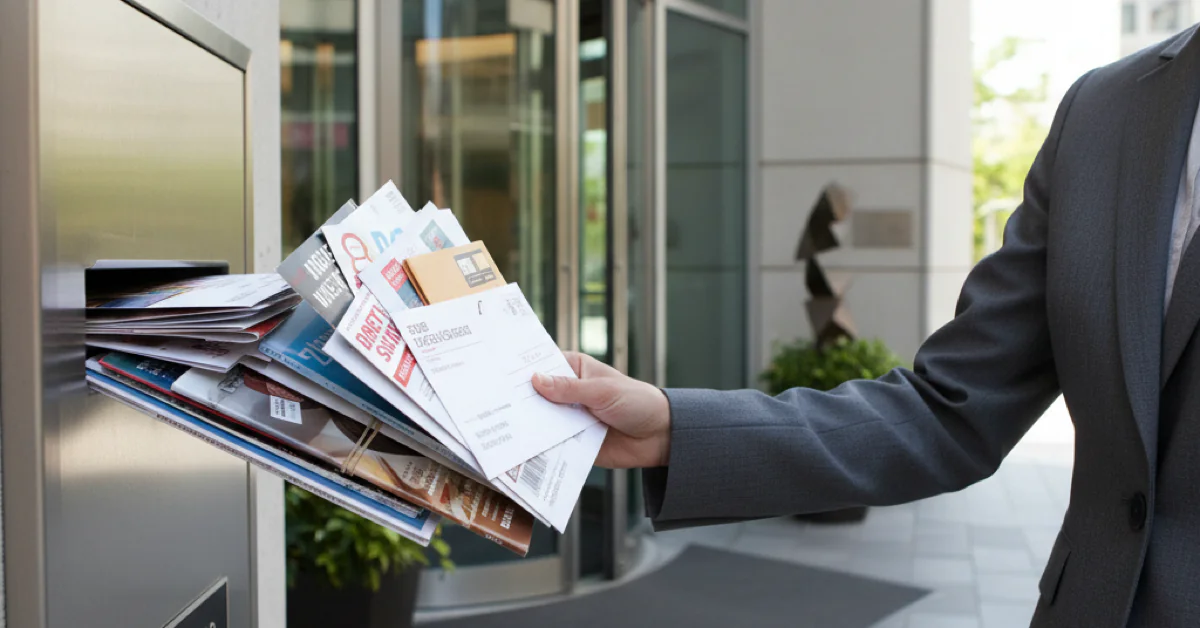
Direct Mail Isn’t Dead: 2026 Response Rates That Prove It
Every few years, someone declares direct mail dead. And every few years, the data says otherwise. The latest 2026 numbers from the ANA/DMA Response Rate Report show direct mail pulling a 4.4% average response rate, compared to email’s 0.12%. That’s 37 times more effective by response rate alone. If you’ve gone all-digital and you’re watching your returns shrink, this article gives you the current data, the reasons behind it, and a practical framework for putting outsourced print and mail services to work alongside your digital campaigns.
What We’ll Cover in This Article
- The 2026 direct mail numbers: what the data actually shows
- Why direct mail is outperforming digital (the science of physical engagement)
- Response rates by industry: where direct mail hits hardest
- Direct mail formats compared: postcards vs. letters vs. dimensional mailers
- How to integrate direct mail with your digital campaigns
- Getting started: a practical direct mail checklist
The 2026 Direct Mail Numbers: What the Data Actually Shows
Let’s start with the headline numbers from the ANA/DMA Response Rate Report (2025 edition, the most current as of early 2026) and supporting research from Lob, PostcardMania, and Vericast.
Response Rates by Channel
| Channel | Average Response Rate | Notes |
|———|———————-|——-|
| Direct mail | 4.4% | ANA/DMA 2025 |
| Email | 0.12% | ANA/DMA 2025 |
| Social media ads | 0.1–1.0% | Varies by platform and targeting |
| Display ads | 0.02–0.10% | Google Display Network average |
Direct mail doesn’t just edge out digital. It’s in a different category entirely. And the revenue impact is even more striking: direct mail leads generate 509% more revenue than digital leads, according to a PostcardMania analysis of 115,393 leads in 2024.
Here’s another number worth noting: 84% of marketers agree that direct mail provides the highest ROI of any channel they use (Lob State of Direct Mail 2025). That’s not nostalgia. That’s marketers looking at their own dashboards and drawing conclusions.
Why Direct Mail Is Outperforming Digital
The “why” behind these numbers comes down to three factors: digital fatigue, physical engagement, and trust.
Digital fatigue is real and growing. According to Lob and CompereMedia’s 2025 consumer research, 58% of consumers feel overwhelmed by digital brand messages. Among high-income consumers (households earning $100K+), that number jumps to 65%. Your emails and display ads are competing with hundreds of other messages daily. A physical mail piece competes with a handful.
Physical mail holds attention longer. People spend 45% longer engaging with direct mail compared to digital ads: 1.6 minutes versus 1.1 minutes, per Vericast’s 2024 research. That extra time matters. It’s the difference between a glance and actual consideration.
Trust favors physical experiences. Lob’s 2025 consumer survey found that 53% of consumers describe direct mail as “real, valuable, and worth keeping.” Meanwhile, 39% of consumers say they’re unlikely to trust a brand that only engages digitally (CompereMedia 2024). And 84% of Gen Z and Millennials say they value brands that blend technology with physical experiences (Harris Poll 2025).
That last point surprises people. Younger consumers aren’t rejecting physical media. They’re rejecting brands that feel one-dimensional.
There’s a broader market reality here, too: 80% of the U.S. economy happens offline, but only 44% of marketing spend goes to offline channels (IRL Marketing Trend Report 2025). That gap is an opportunity.
Response Rates by Industry: Where Direct Mail Hits Hardest
Direct mail response rates vary by industry. Some verticals see consistently strong performance because their audiences expect and respond to physical communication.
Direct Mail Response Rates by Industry
| Industry | Response Rate | Open Rate | Source |
|———-|————–|———–|——–|
| Healthcare | 4.09% | 48.55% | ANA/DMA 2025 |
| Financial services | 3.95% | 46.92% | ANA/DMA 2025 |
| Automotive | 3.84% | 45.56% | ANA/DMA 2025 |
Open rate here refers to the percentage of recipients who open and engage with the mail piece, as measured through tracking methods like QR codes, PURLs (personalized URLs), and call tracking.
Healthcare, financial services, and automotive lead, but the pattern holds across most B2C and many B2B verticals. Industries with considered purchases (where the buyer researches and compares before buying) see the strongest direct mail results because physical mail supports that deliberate decision process.
Direct Mail Formats Compared: Postcards vs. Letters vs. Dimensional Mailers
Not all mail is created equal. The format you choose has a direct impact on response rate, cost, and the type of message you can deliver.
Direct Mail Formats Compared
| Format | Response Rate | Cost Per Piece | Best Use Case | Watch-Outs |
|——–|————–|—————-|—————|————|
| Oversized postcard (6×9 or 6×11) | 2–4% | $0.40–$1.00 | Broad prospecting, event invitations, seasonal offers | Limited space for complex messages |
| Standard letter (envelope) | 3–5% | $1.00–$3.00 | Detailed offers, personalized outreach, financial/healthcare | Higher cost, slower to produce |
| Dimensional mailer | 6–12% | $5.00–$25.00 | High-value prospects, ABM campaigns, executive outreach | High cost per piece, only viable for targeted lists |
Sources: ANA/DMA Response Rate Report 2025
Dimensional mailers (three-dimensional packages or boxes) deliver the highest response rates because they’re impossible to ignore. But at $5–$25 per piece, they only make sense when a single conversion justifies the spend. For most programs, oversized postcards offer the best balance of response rate and cost.
How to Integrate Direct Mail with Your Digital Campaigns
This isn’t about choosing mail over digital. It’s about using both strategically. The integration is simpler than most marketers expect.
Add QR codes and trackable URLs. Campaigns with digital links or QR codes see roughly 9% higher response rates versus static mail pieces (PostcardMania). Every piece should drive recipients to a specific landing page for tracking.
Sequence your touches. A proven approach: send a mail piece first, then follow up with an email referencing it two to three days later. Recognition plus reinforcement.
Retarget mail recipients digitally. Upload your mailing list to your ad platforms and run display or social ads to the same audience. Multiple touchpoints, no additional mail spend.
Use mail for your warmest segments. Direct mail’s higher cost per piece means you should prioritize it for high-value audiences: existing customers, lapsed buyers, and pre-qualified leads. Use digital for awareness, mail for conversion.
Match the format to the funnel stage. Top of funnel: oversized postcards for awareness. Middle of funnel: personalized letters with specific offers. Bottom of funnel: dimensional mailers for direct mail campaign fulfillment on your highest-value targets.
Getting Started: A Practical Direct Mail Checklist
Here’s a practical checklist for your first campaign:
1. Define your audience. Pull a clean, targeted list. Start with your warmest prospects: people who’ve engaged but haven’t converted. List quality matters more than list size.
2. Choose your format. For a first test, oversized postcards (6×9 or 6×11) give you the best combination of cost efficiency and response rate. Keep it simple.
3. Write a clear offer. One message, one call to action. Direct mail works best when it’s focused. Don’t try to communicate everything your company does on a single postcard.
4. Add tracking. Include a QR code, a unique URL, or a dedicated phone number so you can measure response. Without tracking, you can’t calculate ROI.
5. Set your test size. 500–1,000 pieces is enough to generate meaningful response data for most B2B campaigns. B2C may need larger volumes depending on baseline conversion rates.
6. Plan your follow-up. Decide in advance how you’ll follow up with responders. Email, phone call, or a second mail piece? Map this out before you send.
7. Measure and report. Track responses for 4–6 weeks after the drop date. Calculate response rate, cost per response, and cost per acquisition. Compare to your digital benchmarks.
Doceo Pro Tip
Your first direct mail campaign doesn’t need to be complicated. Start with an oversized postcard (6×9 or 6×11) to your warmest prospects. Include a QR code linking to a specific landing page so you can track response. At $0.40–$1.00 per piece with a 2–4% response rate, even a small test run gives you real data to build on.
FAQs
Q: What is the average direct mail response rate in 2026?
A: The most current data (ANA/DMA 2025 report) shows a 4.4% average response rate for direct mail, compared to 0.12% for email. These are the benchmarks heading into 2026.
Q: Is direct mail more effective than email?
A: By response rate, direct mail is 37 times more effective than email and generates 509% more revenue per lead (PostcardMania 2024). Mail costs more per piece, though, so the real comparison is ROI for your specific audience and offer.
Q: How much does a direct mail campaign cost?
A: Oversized postcards run $0.40–$1.00 per piece. Standard letters cost $1.00–$3.00. Dimensional mailers range from $5.00–$25.00. These figures include printing and postage but may not include design or list acquisition.
Q: What industries get the best direct mail response rates?
A: Healthcare (4.09%), financial services (3.95%), and automotive (3.84%) lead per the ANA/DMA 2025 report. Industries with considered purchase decisions perform well because mail supports a deliberate buyer journey.
Q: How do I track direct mail response rates?
A: Use dedicated tracking mechanisms: QR codes, unique landing page URLs (PURLs), unique phone numbers, or promo codes. Each piece should drive to a trackable destination so you can measure response accurately.
Q: Does direct mail work for younger audiences?
A: Yes. 84% of Gen Z and Millennials say they value brands that blend technology with physical experiences (Harris Poll 2025). Younger consumers aren’t anti-mail. They respond to brands that feel intentional and multi-dimensional.
Q: How many pieces should I send for a test campaign?
A: For B2B, 500–1,000 pieces is a reasonable starting point. B2C may need 2,000–5,000 pieces for confident analysis. The key is a clean, targeted list.
Q: Can I combine direct mail with digital marketing?
A: Yes, and you should. Campaigns with QR codes or digital links see roughly 9% higher response rates. Sequencing mail with email follow-ups and retargeting reinforces your message across channels.
Q: How long does it take to see results from a direct mail campaign?
A: Most responses come within 1–3 weeks of the mail hitting homes, but track for a full 4–6 weeks. Some recipients hold onto mail before acting, especially for higher-value purchases.
Next Step
Want a second set of eyes on your situation? Here’s the easiest next step: https://mydoceo.com/lets-talk