

HIPAA-Compliant Print and Mail: What Healthcare Organizations Need to Know
Every piece of paper that leaves your healthcare organization with a patient’s name, account number, or diagnosis on it is protected health information (PHI). That means every print job, every mailing, and every vendor who touches that paper is a HIPAA compliance concern. Most healthcare organizations manage this carefully inside their own walls, but the moment print and mail services go to an outside vendor, many don’t ask the right questions. This article covers what HIPAA requires from print and mail vendors, how to spot compliance gaps, and how to evaluate partners in Pennsylvania.
What We’ll Cover in This Article
- Why print and mail is a HIPAA compliance issue
- What HIPAA requires from print and mail vendors
- Common HIPAA print compliance gaps most vendors have
- How to evaluate a HIPAA-compliant print partner
- What compliant print and mail operations look like in practice
- The cost of non-compliance vs. the cost of doing it right
Why Print and Mail Is a HIPAA Compliance Issue
PHI doesn’t stop being protected when it’s printed on paper. An EOB (Explanation of Benefits) on a production floor, a billing statement in an open mail tray, a test result on a shared printer: these are all potential HIPAA violations.
Healthcare organizations produce enormous volumes of printed PHI every month: patient statements, EOBs, appointment reminders, compliance mailings, and billing correspondence. When any of this work is handled by an outside vendor, that vendor becomes a Business Associate under HIPAA with specific compliance requirements.
The challenge is that most local and regional print shops are not equipped for this. Healthcare organizations in Pennsylvania and across the mid-Atlantic face this gap regularly. HIPAA compliance requires documented processes, physical security controls, staff training, and legal agreements that go beyond standard commercial printing. If you’re currently working with outsourced printing services or considering them for healthcare communications, compliance has to be part of the conversation from the start.
According to Fortune Business Insights, the global healthcare BPO market is projected to grow from $423 billion in 2026 to $757 billion by 2034 at a 7.5% CAGR, driven in part by the need for compliant, specialized service providers.
What HIPAA Requires from Print and Mail Vendors
If a vendor handles PHI in any form, including printed documents, HIPAA requires specific protections. Here’s what the law actually demands.
Business Associate Agreement (BAA)
A BAA is a legally binding contract between a healthcare organization (the covered entity) and any vendor (the business associate) that handles PHI. It must outline what PHI the vendor will handle, how they’ll protect it, what happens in a breach, and how PHI will be returned or destroyed when the relationship ends. Without a signed BAA, your organization is out of compliance the moment a vendor touches PHI.
Chain of Custody Controls
HIPAA requires PHI to be accounted for at every stage: from data receipt through printing, inserting, quality checks, and postal handoff.
Physical and Technical Safeguards
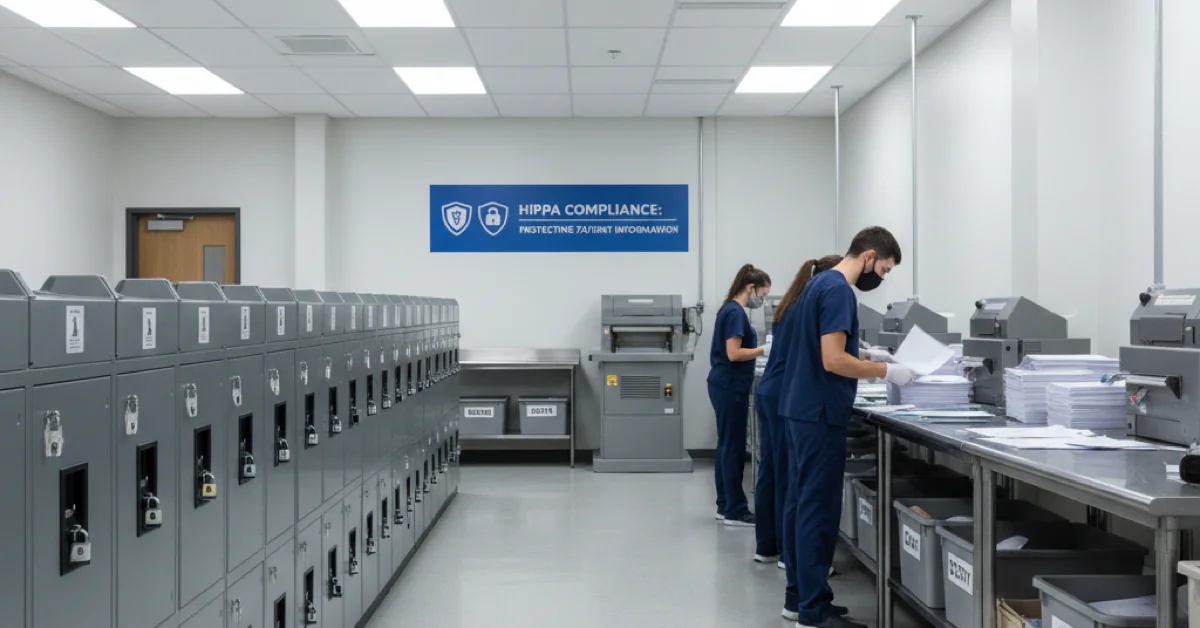
The vendor’s facility must have restricted access to production areas, surveillance systems, secure data transmission (encryption in transit and at rest), workstation security, and visitor access logging.
Workforce Training
Every employee who touches PHI must receive documented, recurring HIPAA training with acknowledgment records.
Destruction and Disposal Protocols
Misprints, test sheets, overruns, and any paper with PHI must be destroyed through compliant methods (cross-cut shredding, pulping, or incineration) with documented destruction records.
Common HIPAA Print Compliance Gaps
These are the areas where most print vendors fall short.
No BAA Available
Many print shops have never been asked to sign a BAA and don’t have one prepared. If your vendor can’t produce a BAA, they can’t handle PHI.
Open Production Floors
Standard commercial print shops have open production areas where employees, delivery drivers, and visitors walk through freely. HIPAA-compliant operations restrict access to authorized personnel only.
No Data Handling Protocols
Receiving patient data via email attachment or unsecured FTP is common in commercial printing. HIPAA requires encrypted transmission, secure storage, and documented procedures. If your vendor says “just email us the file,” that’s a problem.
No Audit Trail
Compliant operations log every job: when data was received, when printed, how many pieces produced and mailed, and how waste was destroyed. Most commercial shops don’t track at the detail level HIPAA requires.
Inadequate Destruction Practices
Tossing misprints in a recycling bin is not compliant. Cross-cut shredding with documented chain of custody is the minimum standard.
How to Evaluate a HIPAA-Compliant Print Partner
HIPAA-Compliant Vendor vs. Standard Print Shop
| Requirement | HIPAA-Compliant Vendor | Standard Print Shop |
|—|—|—|
| BAA available and ready to sign | Yes, with legal review completed | Rarely, or not at all |
| Chain of custody documentation | Full tracking from data receipt through postal handoff | Basic job tracking for billing only |
| Facility access controls | Restricted production areas, badge access, visitor logs | Open floor, minimal restrictions |
| Data encryption (transit and at rest) | Encrypted file transfer, secure storage | Email or FTP, standard file storage |
| Audit trail | Complete job logs with piece-level tracking | Job-level tracking for invoicing |
| Staff HIPAA training | Documented, recurring, with acknowledgment records | None or informal |
| Destruction protocols | Cross-cut shredding with certificates of destruction | Recycling bin |
| Breach notification process | Documented plan with defined timelines | No formal process |
Evaluation Checklist
Ask potential vendors these questions:
- [ ] Can you sign a Business Associate Agreement? (If no, stop here.)
- [ ] Walk me through your chain of custody for a PHI print and mail job.
- [ ] How is data transmitted, and what encryption do you use?
- [ ] Who has access to your production floor?
- [ ] What is your HIPAA training program?
- [ ] How do you destroy waste and misprints containing PHI?
- [ ] Do you have a documented breach notification process?
- [ ] Can you provide healthcare client references?
What Compliant Print and Mail Operations Look Like in Practice
Data Transfer
Patient data is transmitted through encrypted channels, typically SFTP or a secure web portal. No email attachments, no open FTP sites.
Production
Jobs run in a restricted-access area with HIPAA-trained, background-checked staff. Every document is tracked at the piece level from print through insertion into envelopes.
Quality Assurance
Automated verification confirms the right document goes into the right envelope. A single mismatch is a HIPAA breach, so modern production equipment uses barcode scanning to verify every piece.
Mail Processing
Completed mail is held in a secure staging area until postal pickup, with manifests documenting what was sent and when. If you’re looking at print technology solutions built for healthcare environments, integrated tracking from production through delivery is a standard expectation.
Waste Destruction
All waste is cross-cut shredded on-site with a documented destruction log. Certificates of destruction are available on request.
Doceo Pro Tip
Ask your current print vendor one question: “Can you sign a Business Associate Agreement?” If the answer is anything other than an immediate yes with documentation ready to review, you have a compliance gap that needs to be addressed before your next print job ships.
The Cost of Non-Compliance vs. the Cost of Doing It Right
Here’s the reality on cost.
The Cost of Non-Compliance
HIPAA penalties range from $141 per violation for unknowing violations to over $2 million per violation category per year for willful neglect. A single mailing error can trigger an OCR investigation, mandatory breach notification, credit monitoring costs, and reputational damage.
The Cost of Doing It Right
HIPAA-compliant print and mail services do carry a premium over standard commercial printing, typically 10 to 25% higher per job depending on volume and complexity. For central PA health systems managing large patient populations, that premium is especially easy to justify. It covers real protections: secure infrastructure, trained staff, documented processes, and liability sharing through the BAA.
When you factor in the avoided risk, the math is straightforward. Healthcare organizations across Pennsylvania also benefit from consistent quality, postal optimization, and the ability to redirect internal staff to patient-focused work.
FAQs
Q: Does HIPAA apply to all printed patient communications?
A: Yes. Any printed material containing PHI falls under HIPAA protection requirements, including billing statements, EOBs, appointment reminders, test results, and compliance notices.
Q: What is a Business Associate Agreement, and why does it matter?
A: A BAA is a legal contract required whenever an outside vendor handles PHI. Without a signed BAA, both your organization and the vendor are out of compliance.
Q: Can my current print shop become HIPAA compliant?
A: Technically yes, but the investment in facility modifications, security infrastructure, staff training, and process documentation is significant. It’s usually more practical to work with a vendor already built for compliance.
Q: What happens if PHI is exposed during the print and mail process?
A: Any unauthorized disclosure triggers notification requirements. Your organization must notify affected individuals within 60 days. Breaches affecting 500+ people require HHS and media notification as well.
Q: How do I know if my current vendor is truly HIPAA compliant?
A: Ask for their BAA, request a facility tour, ask for HIPAA training documentation, and request healthcare client references. Hesitation or inability to produce documentation is a red flag.
Q: Is email an acceptable way to send patient data to a print vendor?
A: Standard email is not HIPAA compliant for transmitting PHI unless both parties use end-to-end encryption. SFTP or encrypted web portals are the standard.
Q: Are there Pennsylvania-specific requirements for HIPAA-compliant printing?
A: HIPAA is federal, so core requirements apply nationwide. However, Pennsylvania’s Breach of Personal Information Notification Act adds state-level notification requirements. Your vendor should be familiar with both.
Q: What volume of print work justifies using a HIPAA-compliant vendor?
A: If any of your print work contains PHI, compliance is required regardless of volume. Higher volumes make the cost premium easier to absorb per piece.
Next Step
Not sure whether your current print and mail setup meets HIPAA requirements? We’re happy to talk it through.