

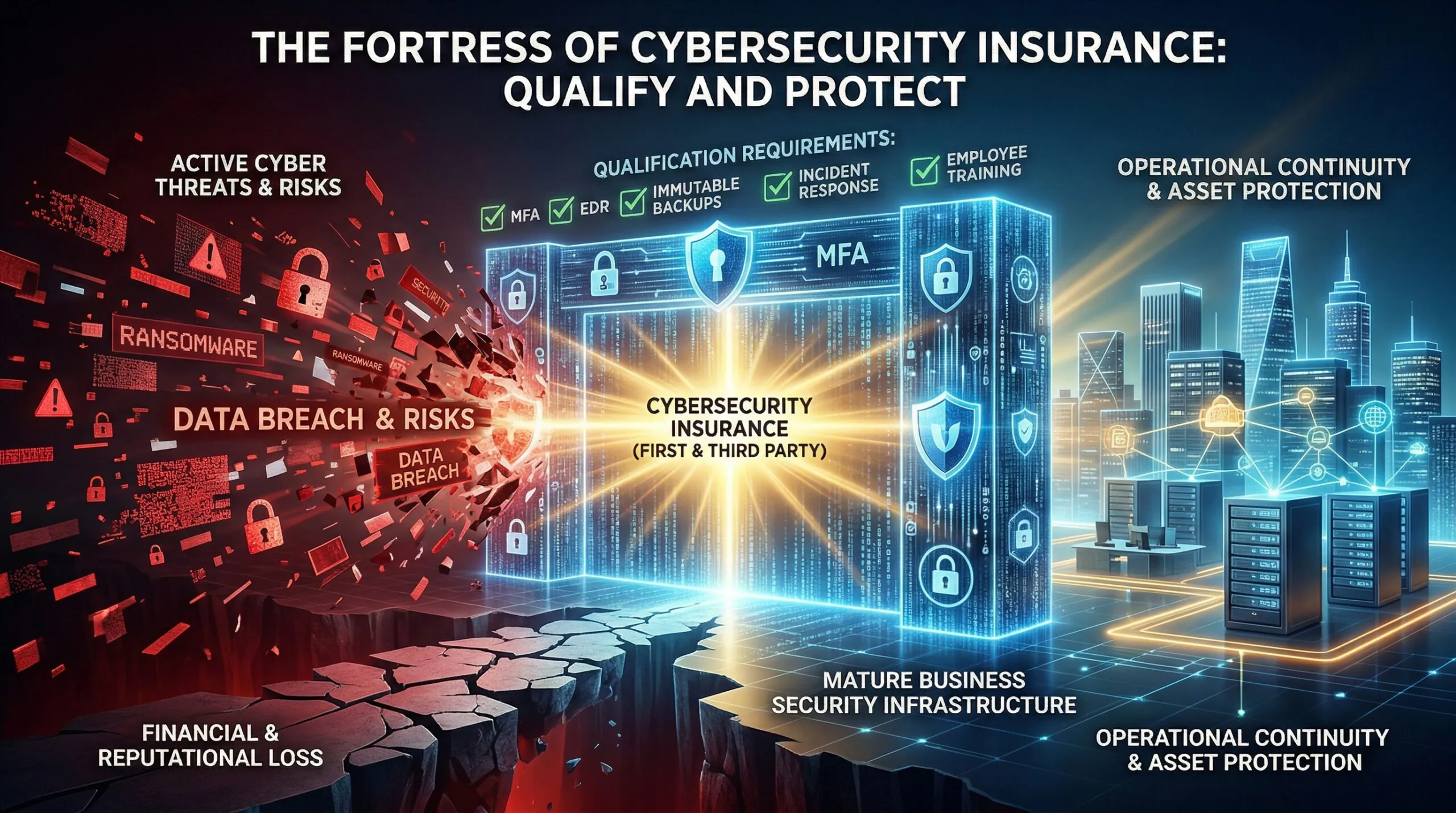
A data breach doesn’t just cost you data. It costs you money, customer trust, and time you can’t get back. Cybersecurity insurance exists to absorb that financial hit, but most small businesses either don’t carry it, don’t understand what it covers, or can’t qualify because their security isn’t strong enough.
This guide breaks down what cybersecurity insurance for businesses actually covers, what it typically costs, what security measures insurers now require, and how to evaluate whether your organization is ready for a policy. We’re writing this as the people who build and manage the security infrastructure that insurers evaluate, not as an insurance company selling you a policy.
What We’ll Cover in This Article
- What cybersecurity insurance is and what it actually covers
- How much cyber insurance costs for small businesses
- What security requirements insurers expect in 2026
- How to choose the right cyber insurance policy
- How your IT security posture affects your premiums
- Common mistakes businesses make with cyber insurance
- Frequently asked questions about cybersecurity insurance
What Is Cybersecurity Insurance (and What Does It Actually Cover)?
Cybersecurity insurance, sometimes called cyber liability insurance, is a type of business insurance designed to protect against financial losses caused by cyber incidents. That includes data breaches, ransomware attacks, business interruption from system outages, and the legal costs that follow.
Here’s the first thing most business owners get wrong: general liability insurance does not cover cyber incidents. If a hacker encrypts your files or steals customer data, your standard business policy almost certainly won’t help. You need a separate cyber insurance policy, or at minimum a cyber endorsement added to your existing coverage.
Two Types of Coverage You Need to Know
Cyber insurance policies typically include two categories of protection: first-party coverage and third-party coverage.
First-party coverage protects your business against your own direct losses. If ransomware locks your systems and you lose three days of revenue while your team scrambles to recover, first-party coverage helps pay for that. It typically includes data recovery costs, business interruption losses, ransomware payments (where permitted), forensic investigation fees, and the cost of notifying affected customers.
Third-party coverage protects you when someone else brings a claim against your business after a cyber incident. If customer data is stolen and they sue, or if a regulator issues fines, third-party coverage pays for legal defense, settlements, and regulatory penalties.
Most policies include both types, but the limits, sub-limits, and exclusions vary significantly from one carrier to another. That’s why reading the fine print matters more with cyber insurance than almost any other policy type.
| Coverage Type | What It Covers | Example Scenario |
|---|---|---|
| First-party | Your direct losses | Ransomware locks your files; policy covers ransom payment, data recovery, and lost revenue during downtime |
| Third-party | Claims from others | Customer data is stolen; policy covers lawsuit defense, settlements, and regulatory fines |
If your business stores customer data, processes payments, or depends on digital systems to operate (and in 2026, that’s nearly every business), understanding these two categories is step one. Building the layered cybersecurity protection that makes you insurable in the first place is step two.
How Much Does Cyber Insurance Cost for Small Businesses?
For most small and mid-sized businesses, cyber insurance premiums fall in the range of $500 to $5,000 per year. That’s a wide range, and where your business lands depends on several factors that insurers weigh during the underwriting process.
What Drives the Price Up or Down
Your industry matters. Businesses in healthcare, financial services, and legal sectors handle highly regulated, sensitive data and tend to pay more. A small accounting firm with access to client tax records and Social Security numbers carries more cyber risk than a landscaping company, and insurers price accordingly.
The volume and sensitivity of data you handle also plays a role. If you’re storing personally identifiable information (PII), payment card data, or protected health information (PHI), your exposure is higher.
Your security posture is one of the biggest factors, and it’s the one you have the most control over. Businesses with multi-factor authentication (MFA) deployed, endpoint detection and response (EDR) tools active, tested backups, and a documented incident response plan consistently see lower quotes than businesses without those controls. We’ll get into the specifics of what insurers require in the next section.
Revenue also factors in: higher revenue generally means more exposure, which means higher premiums. And if your business has a history of prior claims or breaches, expect that to show up in the pricing too.
Deductibles on cyber policies typically range from $1,000 to $10,000, depending on the policy and your coverage tier.
| Factor | Increases Premiums | Decreases Premiums |
|---|---|---|
| Industry | Healthcare, finance, legal | Lower-risk sectors with minimal PII |
| Data sensitivity | PII, payment data, health records | Non-sensitive operational data |
| Security posture | No MFA, no EDR, no tested backups | MFA, EDR, tested backups, training |
| Revenue | Higher revenue = more exposure | Lower revenue (relative) |
| Claims history | Prior breaches or claims | Clean history |
For a more detailed breakdown of cyber insurance basics, the FTC’s guide to cyber insurance for small businesses is a solid, vendor-neutral resource.
What Security Requirements Do Insurers Expect in 2026?
This is where things have changed the most. Three years ago, many small businesses could fill out a short questionnaire and get a cyber insurance policy without much scrutiny. That’s no longer the case. Insurers have tightened their requirements dramatically after paying out billions in ransomware claims, and the bar for insurability keeps rising.
Here are the core security controls most insurers now expect before they’ll issue a policy, or at least before they’ll issue one without crippling exclusions:
1. Multi-Factor Authentication (MFA)
MFA on email, VPN, remote desktop access, and administrative accounts is non-negotiable for nearly every insurer. If your team is still logging into email or remote systems with just a password, most carriers will either decline the application or add exclusions that make the policy much less useful. For a closer look at how different authentication methods compare, see this guide on understanding MFA and authentication methods.
2. Endpoint Detection and Response (EDR)
Endpoint detection and response is the modern replacement for traditional antivirus software. Where antivirus scans for known threats, EDR actively monitors endpoint behavior, detects suspicious activity in real time, and can automatically isolate compromised devices. Insurers want EDR because it dramatically reduces the window between an attack starting and someone noticing.
3. Tested Backups
Not “we have backups somewhere.” Insurers want to see that your backups are tested regularly, that they’re stored in a way that ransomware can’t encrypt them (air-gapped or immutable), and that you’ve actually verified you can restore from them. Untested backups are the same as no backups when a real incident hits.
4. Incident Response Plan
A documented, tested incident response plan that your team has actually practiced. Not a template downloaded from the internet that’s sitting in a shared drive. Insurers want to know that when something goes wrong, your organization has a playbook for containment, communication, and recovery.
5. Employee Security Awareness Training
Regular training, not a once-a-year checkbox exercise. Phishing remains the most common attack vector, and insurers know that the best technical controls in the world can be bypassed by one employee clicking the wrong link. They want to see evidence of ongoing training programs.
6. Patch Management
Systems patched within a reasonable window, typically 30 days for critical vulnerabilities. Unpatched systems are one of the top reasons insurers deny claims after the fact.
7. Privileged Access Management
Administrative access should be controlled, limited, and audited. If everyone on your team has admin rights to everything, that’s a red flag on the application.
Here’s the empowering part: these aren’t just insurance requirements. They’re the same security practices that protect your business whether you carry a policy or not. Meeting insurer standards doesn’t just qualify you for coverage; it makes your organization genuinely harder to breach.
How to Choose the Right Cyber Insurance Policy
Before you start comparing quotes, start with a risk assessment. What data does your business hold? What systems would grind operations to a halt if they went down? What’s your realistic exposure if a breach happened tomorrow?
Once you’ve mapped your risk, here are the key questions to ask when evaluating cyber insurance policies:
1. Does the coverage limit match your realistic exposure?
A $100,000 policy sounds reasonable until you learn that the average cost of a data breach for a small business exceeds $150,000 when you factor in forensics, notification, legal fees, and lost revenue. Match the limit to the risk, not just the budget.
2. What’s excluded?
This is where most policies get people. Common exclusions include “acts of war” (which some carriers have tried to apply to nation-state cyberattacks), unpatched systems, social engineering losses, and incidents involving known but unfixed vulnerabilities. Read the exclusions page as carefully as the coverage page.
3. Does the policy cover ransomware payments?
Some policies don’t, or they cap ransomware coverage at a sub-limit far below the main policy limit. If ransomware is a concern (and for most businesses it should be), verify this explicitly.
4. Does it include breach notification costs?
State breach notification laws require businesses to notify affected individuals, and the costs add up fast: credit monitoring, mailing, call center setup. Make sure the policy covers these.
5. Is there access to an incident response team through the policy?
Some of the better policies include access to pre-vetted forensics firms, legal counsel, and crisis communication experts. This can be extremely valuable during the chaotic first hours of an incident.
6. What’s the deductible, and is it manageable?
A lower premium with a $25,000 deductible might not actually save you money if a mid-size incident costs $30,000 total.
Policy Evaluation Checklist
- ✔️ Coverage limit matches realistic exposure
- ✔️ Exclusions reviewed and understood
- ✔️ Ransomware coverage included (or consciously excluded)
- ✔️ Breach notification costs covered
- ✔️ Incident response resources included
- ✔️ Deductible is manageable
- ✔️ Policy reviewed by a cyber-specialized broker
Work with a broker who specializes in cyber insurance, not a general insurance agent. The cyber insurance market changes fast, and a specialist will know which carriers are offering competitive terms for your industry and risk profile. Your IT provider can also help you understand what security controls you already have versus what you’d need to add before applying.
How Your IT Security Posture Affects Your Premiums
Insurance is a risk equation. The insurer is betting on how likely you are to file a claim and how expensive that claim would be. Better security means lower risk on both fronts, which translates directly to lower premiums.
Businesses with mature security programs, where MFA is deployed across the organization, EDR is actively monitored, backups are tested quarterly, and employees receive ongoing training, can see premiums 15 to 30 percent lower than businesses that haven’t invested in those controls. Over the life of a policy, that savings can be substantial.
But there’s a more fundamental issue than price: the “insurability gap.” Some businesses literally cannot get coverage because their security posture is too weak. Carriers will decline the application outright, or they’ll issue a policy with so many exclusions that it’s effectively useless. If you don’t have MFA on email and remote access, for example, most insurers won’t even start the conversation.
The investment in security infrastructure often pays for itself through three channels: reduced premiums, fewer actual incidents (because your defenses are stronger), and the ability to get meaningful coverage in the first place.
A cyber risk assessment is the practical first step to understanding where your business stands. It identifies the gaps between your current security posture and what insurers (and common sense) require. For a broader look at how small businesses should think about cybersecurity, our cybersecurity guide for SMBs covers the foundations. And if you want to benchmark your current IT provider’s performance, the guide on measuring your IT security performance is a good starting point.
Common Mistakes Businesses Make With Cyber Insurance
Most of the costly mistakes with cyber insurance happen before a claim is ever filed. Here are the ones we see most often:
1. Assuming General Liability Covers Cyber Incidents
It doesn’t. Standard general liability and commercial property policies almost always exclude cyber events. If you assume you’re covered and find out you’re not after a breach, you’re absorbing the full cost yourself. Cyber coverage requires its own policy or a specific endorsement.
2. Buying a Policy Without Reading the Exclusions
The exclusions section is where claims get denied. War exclusions, unpatched-system clauses, social engineering carve-outs, and “failure to maintain” provisions are all common. If your policy excludes ransomware payments or incidents involving known vulnerabilities, and that’s the exact scenario that hits you, the policy won’t help.
3. Underinsuring
Choosing the cheapest policy without matching coverage limits to your actual exposure is a common and expensive mistake. A $50,000 policy won’t make a meaningful dent in a $500,000 breach response. Get realistic about your exposure before choosing a coverage tier.
4. Failing to Meet Policy Requirements After Purchase
Some policies require ongoing security measures as a condition of coverage. If the application states that you have MFA deployed and you later disable it, or if you stop patching systems, a claim can be denied for misrepresentation. The security standards you report on the application need to be the security standards you maintain.
5. Treating Insurance as a Substitute for Security
Insurance covers the financial aftermath. It doesn’t prevent the breach, the operational downtime, the customer calls, or the reputational damage. A strong security program reduces the chance of an incident in the first place. Insurance is the financial backstop, not the frontline defense.
6. Not Involving Your IT Team in the Application
The security questionnaire on a cyber insurance application determines both your eligibility and your pricing. It’s full of technical questions about MFA deployment, backup frequency, EDR coverage, and patching timelines. If someone in accounting fills it out by guessing, you risk either overpaying (because answers were conservative) or having a claim denied later (because answers were inaccurate). Your IT team or provider should review the application.
Doceo Pro Tip
When you’re filling out a cyber insurance application, have your IT provider at the table. The security questionnaire is where eligibility and pricing get decided, and it’s full of technical questions about MFA deployment, backup frequency, EDR coverage, and more. Getting those answers wrong, or guessing, can mean higher premiums or a denied claim down the road. Your IT provider knows exactly what’s deployed, what’s configured, and what might need upgrading before you apply.
Frequently Asked Questions
Does my small business need cybersecurity insurance?
If your business stores customer data, processes payments, or relies on digital systems to operate, yes. Cyberattacks increasingly target small and mid-sized businesses because they often have fewer defenses. The financial impact of a breach, including forensics, legal costs, notification, and lost revenue, can be severe enough to close a small business permanently.
How much does cyber insurance cost for a small business?
Typically between $500 and $5,000 per year, depending on your industry, the type of data you handle, your revenue, and your security posture. Businesses with strong security controls consistently see lower premiums than those without.
What does cybersecurity insurance actually cover?
Two main categories: first-party coverage (your direct losses from an incident, including data recovery, business interruption, ransomware payments, and notification costs) and third-party coverage (claims others bring against you, including lawsuits, regulatory fines, and legal defense). See the coverage section above for a detailed breakdown.
What’s the difference between first-party and third-party cyber coverage?
First-party covers your own losses: the cost to recover your data, the revenue you lose during downtime, the expense of notifying customers. Third-party covers claims from others: lawsuits filed by affected customers, regulatory fines from state or federal agencies, and the legal costs to defend against those claims.
What security measures do insurers require in 2026?
At minimum: multi-factor authentication (MFA) on email and remote access, endpoint detection and response (EDR), tested and recoverable backups, a documented incident response plan, regular employee security training, and timely patch management. Many carriers also ask about privileged access management. See our detailed requirements section above.
Can a cyber insurance claim be denied, and why?
Yes. Common denial reasons include: not meeting the security requirements stated on your application (such as claiming MFA is deployed when it isn’t), the incident falling under a policy exclusion (war clauses, unpatched systems, social engineering), or material misrepresentation during the application process.
How do I lower my cyber insurance premiums?
Strengthen your security posture. Deploy MFA across your organization, implement EDR on all endpoints, test your backups regularly, train your employees on phishing and social engineering, and document your incident response plan. Businesses with mature security programs can see premiums 15 to 30 percent lower than those without.
Is cyber insurance required by law?
Not by federal law in the United States, but it may be effectively required by industry regulations, contractual obligations, or state-level requirements. Healthcare organizations handling PHI, financial firms under state insurance regulations, and businesses with government contracts often find that cyber insurance is a practical necessity, even if not a strict legal mandate.
What happens if I have a breach and no cyber insurance?
You pay everything out of pocket: forensic investigation, legal counsel, customer notification, credit monitoring, regulatory fines, and lost revenue during downtime. For many small businesses, the combined cost of an uninsured breach is a business-ending event.
Does general liability insurance cover cyber incidents?
No. General liability policies typically exclude digital events, data breaches, and cyber-related losses. You need a dedicated cyber insurance policy or a cyber-specific endorsement added to your existing coverage. Do not assume your current business insurance covers cyber risk without verifying with your carrier.
Take the Next Step
If you’re evaluating cybersecurity insurance for your business, or trying to figure out whether your security is strong enough to qualify, we can help you assess where you stand. No pressure, no pitch. Just a clear picture of your current security posture and what it would take to meet insurer requirements.