
What Is a Large Format Printer?
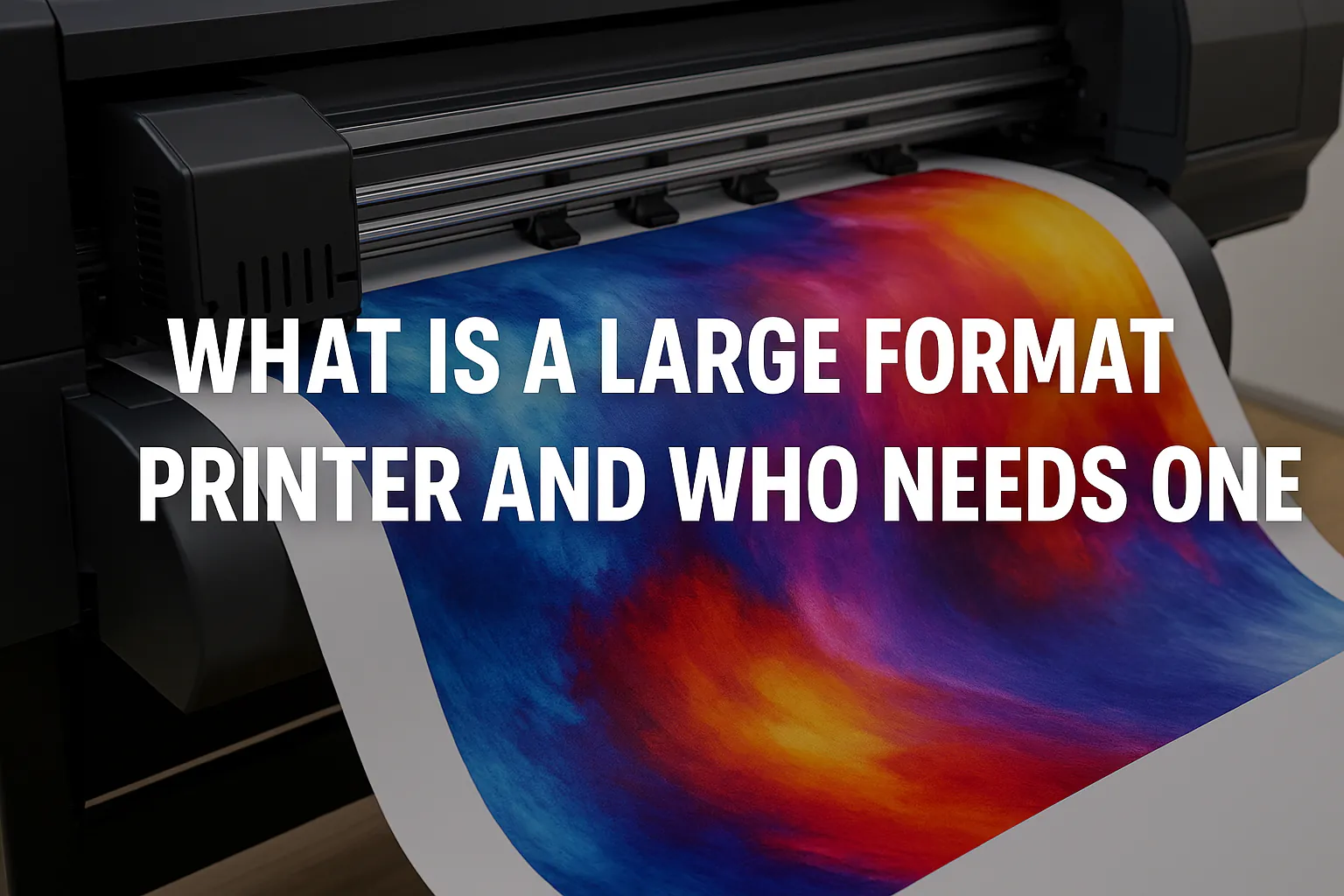
A large format printer (also called a wide-format printer) is a specialized printing device designed to handle materials that are too wide for standard printers, typically anything over 24 inches in width. These machines are engineered to produce high-resolution images on large surfaces such as banners, blueprints, posters, signs, vehicle wraps, and even textiles.
But it’s not just about size. Large format printers support a variety of media (vinyl, fabric, film, paper, canvas) and ink types (dye, pigment, UV-curable, solvent-based), offering tremendous flexibility depending on the industry and application.
How Large Is “Large”?
- Standard Print Widths: 24”, 36”, 44”, 60”, and up to 100”+
- Print Length: Virtually unlimited; media often comes in long rolls
- Resolution: Many models exceed 1,200 DPI (dots per inch) for photo-quality output
Who Needs a Large Format Printer?
Large format printers aren’t just for print shops. They serve a wide range of industries that need impactful visual communication or technical documentation on a larger scale. Here’s a breakdown by industry:
1. Architecture, Engineering, and Construction (AEC)
These professionals rely on precision and clarity in blueprints, CAD drawings, and schematics. A large-format printer can output full-scale plans with pinpoint accuracy, eliminating the need for costly outsourcing or multiple-page patchworks.
2. Retail and Franchise Operations
In-store signage, window graphics, floor decals, and promotional posters all require vivid color and scale. For franchises, large-format printers ensure brand consistency across locations.
3. Marketing and Creative Agencies
Designers use these printers to produce mockups, campaign signage, and experiential graphics. The ability to control quality and timing in-house can make or break a client pitch.
4. Educational Institutions
From event banners to classroom posters, schools and universities benefit from on-demand, low-cost printing. Some institutions also use them for student projects or administrative needs.
5. Manufacturing and Warehousing
Labels, safety signs, floor plans, and quality-control documentation often need to be printed in larger formats, especially when visibility and durability are critical.
6. Event Planners and Exhibit Designers
When you’re managing an event or trade show booth, signage must be bold, consistent, and available fast. With in-house large format printing, there’s no waiting for vendors.
Key Features to Consider Before Buying
If you’re exploring whether a large-format printer makes sense for your business, consider these core features:
1. Media Compatibility
Will you print on canvas, vinyl, or backlit film? Choosing a printer that supports your desired substrates is critical for performance and durability.
2. Print Volume & Speed
Not all large-format printers are built for high-volume production. Some are designed for occasional jobs, while others support 24/7 environments.
3. Color Accuracy and Ink Technology
For industries where color fidelity matters (e.g., branding or photography), pay attention to printers that offer color calibration tools, ICC profiles, or even spectrophotometers.
4. Software Integration
Your printer should integrate seamlessly with CAD tools, RIP software, or print management platforms like PaperCut or uniFLOW for job tracking and cost control.
What Does a Large Format Printer Cost?
Prices vary significantly based on features and intended use:
- Entry-Level Models: $2,000–$5,000
- Mid-Range (for graphic and CAD work): $6,000–$12,000
- High-End Production Models: $15,000–$50,000+
Keep in mind the Total Cost of Ownership (TCO), including ink, media, maintenance, and energy consumption.
In-House vs. Outsourced Printing: What’s More Cost-Effective?
Many businesses assume that outsourcing large print is cheaper, but that’s not always the case.
Pros of In-House Printing:
- Faster Turnaround: Immediate access means no waiting on vendors
- Control Over Quality: Tweak colors, layouts, and prototypes instantly
- Reduced Long-Term Costs: For businesses with consistent output needs, owning a printer is often more cost-effective
When Outsourcing Makes Sense:
- One-off or low-frequency jobs
- Specialty printing (e.g., metallic inks, dye sublimation)
- Limited office space or personnel for maintenance
Are Large Format Printers Difficult to Maintain?
Not necessarily. Many modern models are designed for low-touch maintenance, with features like:
- Self-cleaning printheads
- Automated nozzle checks
- Remote diagnostics
- Customer Replaceable Units (CRUs) for toner and fuser modules
Still, working with a service provider like Doceo ensures that maintenance doesn’t slow down your operations. We offer proactive monitoring and support to keep your device running optimally.
What’s the ROI on a Large Format Printer?
The ROI largely depends on usage. For example:
- A construction firm printing 100 plan sets per month could save $2,000–$3,000/year by switching to in-house printing.
- A retailer that updates its weekly signage can reclaim hours of lead time and eliminate rush-order vendor fees.
- Schools and universities can reduce their annual printing spend by thousands, while empowering staff with creative autonomy.
Beyond financial ROI, the real win is control over quality, branding, and timelines.
Final Thoughts: Should You Invest in a Large Format Printer?
If your business frequently prints oversized materials—or if delays from outsourced vendors are hurting productivity—then a large format printer could be a game-changer. It’s not just a tool; it’s a competitive advantage.
That said, the right solution depends on your specific needs: volume, media, speed, and workflow integration. That’s where expert guidance makes all the difference.
Ready to Explore the Right Large Format Printer for Your Business?
At Doceo, we help organizations find the perfect fit—from evaluating your print needs to selecting the right model and supporting it long-term. Whether you’re printing architectural plans, marketing signage, or event graphics, our team is ready to help you streamline your process and save money.
Frequently Asked Questions About Large Format Printers
What qualifies as a large format printer?
A large format printer is generally defined as any printer capable of producing output wider than 24 inches. That distinguishes it from standard desktop or office printers, which top out well below that threshold. Some manufacturers use the term for devices starting at 17 or 18 inches, but the 24-inch mark is the most widely recognized baseline. At the upper end, large format printers can handle widths of 60 inches, 100 inches, or more, depending on the application.
What is the difference between inkjet and laser for large format printing?
Inkjet dominates the large format market because it handles the wide range of media and color demands that large format work requires, from fine art photo prints to vinyl banners to CAD drawings. Laser and LED-based large format printers exist and are well-suited for high-volume technical document printing, like engineering drawings, where speed and precision matter more than photographic color range. For most organizations, the choice comes down to what you’re printing: inkjet for graphics and photography, laser or LED for technical line work at volume.
Who actually needs a large format printer?
Architecture firms, engineering companies, construction contractors, and municipalities that produce frequent CAD drawings and blueprints are the most obvious candidates. Retail businesses that produce in-house signage, educational institutions printing posters and displays, photographers, and marketing teams with regular large-scale print needs also benefit from having the capability in-house. If you’re currently outsourcing large format work to a print shop with any regularity, it’s worth running the numbers on whether bringing that capability in-house makes financial sense.
What does it actually cost to own and operate a large format printer?
Hardware costs range widely, from a few thousand dollars for an entry-level 24-inch inkjet up to tens of thousands for a production-grade wide-format system. Beyond the purchase price, ongoing costs include ink or toner, specialty media, printheads (which wear over time on inkjet units), and maintenance. Output cost per square foot varies by media type and ink coverage. Getting a realistic cost-per-print estimate from your vendor before purchasing is important, because the hardware price is often just part of the total ownership picture.
What does maintenance look like for a large format printer?
Large format inkjet printers require regular printhead cleaning cycles, media path checks, and ink system maintenance to stay in good working order. Letting a machine sit idle for extended periods without running maintenance prints can cause ink to dry in the heads, which is one of the more common and avoidable causes of print quality problems. Laser and LED large format units tend to have simpler maintenance profiles. Regardless of technology, having a service agreement in place is worthwhile given the cost of these machines. Doceo supports large format equipment across multiple brands, and our team can help you build a maintenance plan that fits your usage.
Contact Doceo today to schedule a free consultation or request a customized quote.
Proven Technology. Proven People.